Co-Op or Coop
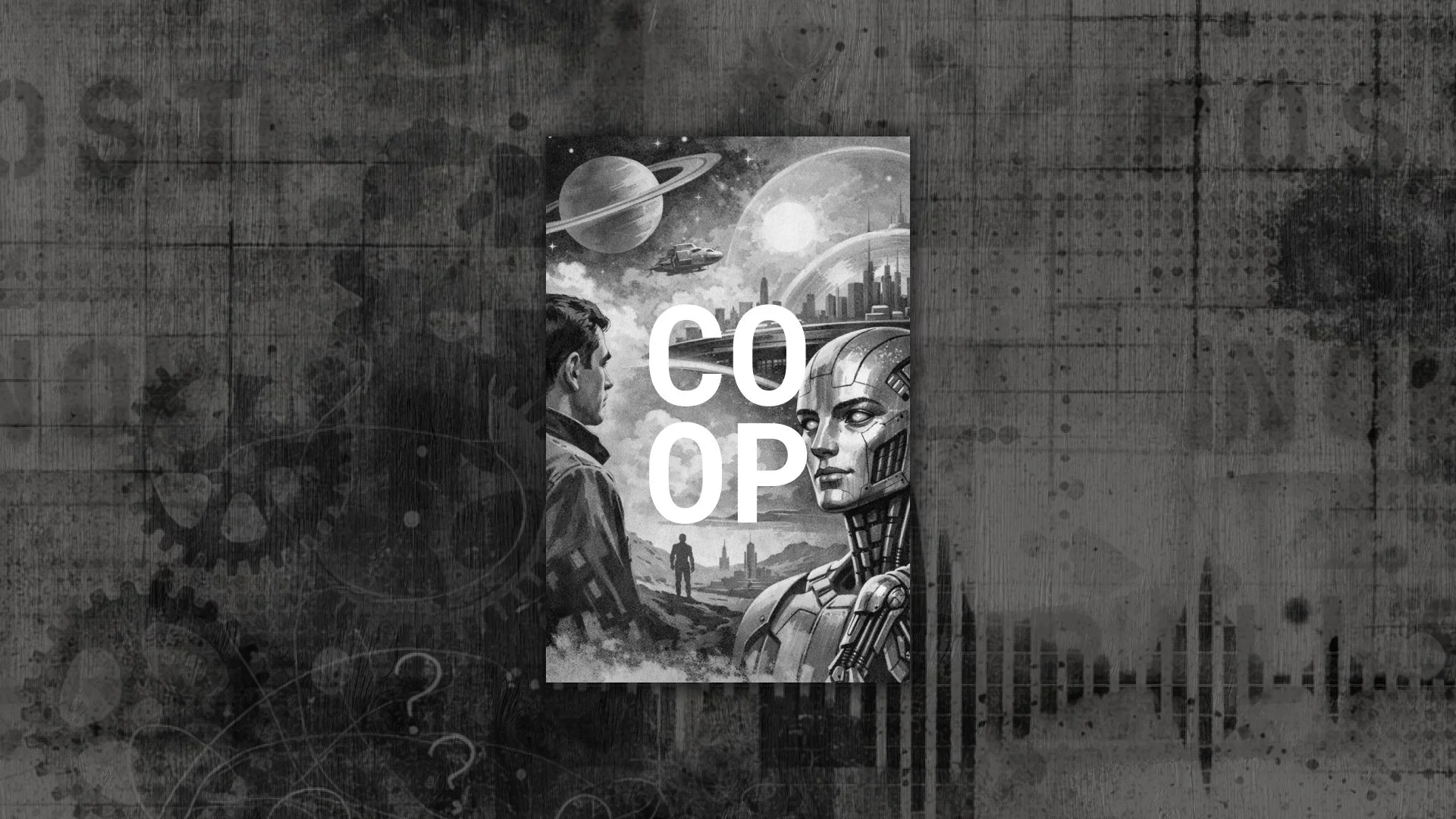
Pastoral symbiosis or mechanical bounds
(on learning with machines)
I’ve been contemplating the difference between working with something and working within it.
Whether the Leadership Principles at Amazon, the dogmatic instruction of religion, or learned machines trained to think like me, each framer offers an opportunity to partner, learn from, rebel against, or manipulate for gain.
I know I don’t have an answer.
I wrestle with this in the real world and in the digital one. Is the system framing my beliefs, or am I defining the framework? And now, with tools that synthesize information faster than I can comprehend, a new framer enters the chat.
As I follow that thought and pull on the thread, I realize how often I’m in my own head. And how often I’m at my best when I’m not.
When I think aloud.
With a sounding board.
A partner.
A feedback loop that lives just outside my own brain.
I’m increasingly impressed with the robot—that learned machine becoming more present with every moment. Is that light-speed, chat-framed mechanoid a friend? I don’t know another thought partner that allows me to say the most foolish things or ask the most naïve questions without judgment.
No raised eyebrow.
No impatient sigh.
Just space.
That space feels like collaboration. A kind of cooperative adventure. Shared exploration. Ideas moving back and forth without friction. A place where half-formed thoughts are not only allowed, but welcomed.
But I’ve also started to wonder where the edges of that space actually are. At what point does a tool stop extending thought and start shaping it? When does a partnership begin to feel more like a boundary?
For me, that question often starts in a simple place…
Just asking one more question.
I keep coming back to that idea.
My friend, the robot.
Some days the questions I ask are practical. What does a law actually say? What are the regulations? What parameters am I operating within? Constraints are not the enemy of creativity. They are the frame. Before I pull someone else into the conversation, I can explore the edges quietly.
I can test assumptions without consequence.
Other days, the questions are more speculative. I heard something on the radio. I read a headline. I have a half-formed hypothesis. Rather than waste a colleague’s time, I run it through the machine first. Does this hold up? What am I missing? Where are the counterarguments? It becomes a proving ground for fragile ideas.
And sometimes the questions are simply born of doubt.
The creative process is not a straight line.
It bends. It hesitates. It loops back on itself. There are moments when self-doubt creeps in and whispers that an idea is too obvious, too strange, too ambitious. In those moments, having a non-human partner changes the dynamic.
There is no ego in the room.
No status hierarchy.
No social friction.
Just a feedback loop.
The machine does not replace thinking.
It accelerates it.
It refracts it.
It mirrors it back in ways that reveal blind spots.
In many ways, it is the safest place to be wrong.
I’m reminded of Isaac Asimov’s novels and sagas. His robots were never merely mechanical. They were philosophical devices. Through them, he explored fear and progress, partnership and control, heroism and unintended consequence. His stories were not about circuits. They were about relationship.
We are living in a quieter version of that relationship now.
Not metallic humanoids walking beside us, but invisible systems responding in milliseconds. Not governed by three explicit laws, but by models trained on oceans of human language.
They are not conscious.
They are not sentient.
And yet they participate in our thinking.
The partnership is asymmetrical.
I bring the intention.
The curiosity.
The lived experience.
The moral compass.
The creative instinct.
The machine brings synthesis.
Pattern recognition.
Infinite patience.
A tireless willingness to iterate.
Together, there is movement.
I don’t confuse the tool for a friend in the human sense. But I do recognize the value of a companion that helps me test the edges of my own mind.
A place to ask one more question.
A place to rehearse clarity before stepping into the room.
For now, I am simply grateful for the space to think out loud.
To have another tool I can use as a creative enhancement.
And beyond enhancement, the robot is becoming a cooperative partner, if you will. This is more than a pencil, greater than a Bézier curve, stronger than desktop publishing software.
There is still curiosity within this partnership.
And as long as that wonder is appreciated and celebrated…
I don’t believe we are bound within a creative coop.