Work Planning and Frequency
On rhythm, narrative, and the architecture of momentum
Most organizations plan in lists.
Q1 priorities. Campaign calendars. Project trackers. Launch dates.
All necessary. All useful.
But lists don’t create rhythm. And rhythm is what turns work into momentum.
I’ve come to think about planning not as sequencing tasks, but as designing frequency.
The Taxonomy of Work
Libraries organize knowledge into systems. Literature organizes meaning into forms. Epics contain stories. Stories contain chapters. Chapters contain moments.
Creative organizations are no different.
If the business aligns on a Grand Narrative—the reason for being, the arc of the year, the thesis of the enterprise—then everything else can find its place.
From that narrative emerge Epics.
Campaigns. Product launches. Events. Platform evolutions.
Bodies of work with gravity. Defined initiatives with a beginning, middle, and end.
Within each Epic live Stories.
Go-to-market plans. Channel strategies. Content arcs.
They are the structured expressions of intent. They can be concepted. Sequenced. Calendared.
And inside each Story are Moments.
Individual deliverables. Assets. Emails. Social posts. Landing pages. Signage. Scripts.
Briefed. Scheduled. Reviewed. Released.
When this taxonomy is clear, planning becomes less reactive and more musical.
The Sound of Work
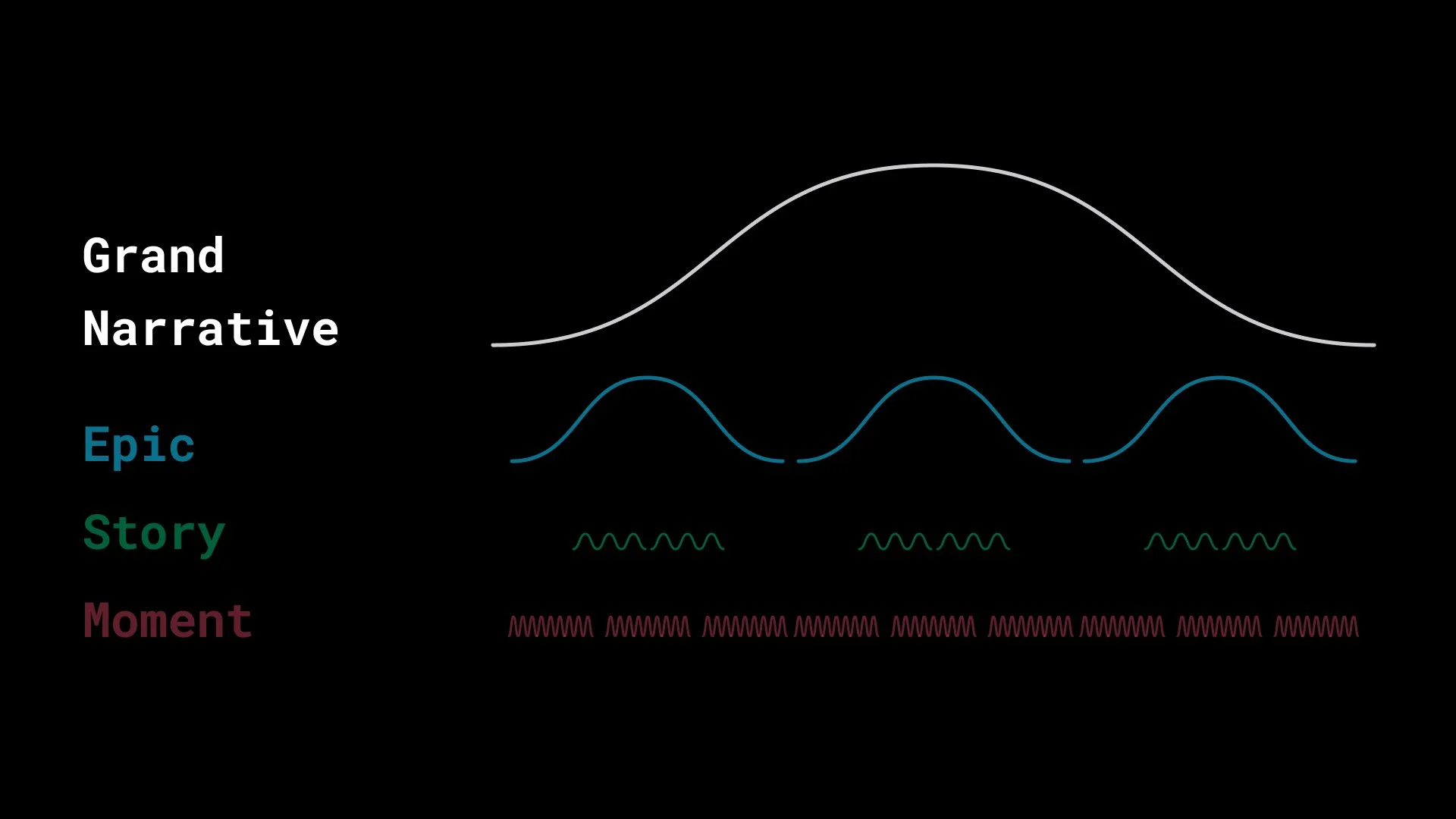
I visualize this model like sound waves.
The Grand Narrative moves slowly—a long, steady arc across the year.
Epics rise and fall in measured cycles. Stories oscillate with tighter rhythm. Moments pulse rapidly at the front line of production.
Different frequencies. Same song.
When each layer understands its cadence, the organization begins to feel cohesive. Not because everyone is doing the same thing, but because everyone is playing in time.
It’s jazz.
Improvisation exists — it must. Markets shift. Opportunities appear. A player takes a solo. But the solo only works because the band knows the standard. Because the key is agreed upon. Because the tempo is felt collectively.
Improvisation without structure is noise. Structure without improvisation is lifeless.
The art is in the balance.
Planning as Composition
When the taxonomy is fully realized, something powerful happens.
Creative teams can be resourced intentionally.
Program managers can forecast load against capability. Marketing calendars become expressions of strategy rather than reactions to requests. Production teams move from scrambling to performing. Capacity planning stops being guesswork and becomes composition.
You begin to see:
When Epics overlap and overload the system.
When Stories are underdeveloped relative to their ambition.
When Moments are being created without a narrative home.
When the frequency is too high and the organization is vibrating into burnout.
And equally important:
When there is space to solo.
When a team can push craft.
When something deserves to be louder.
The Foundation
None of this works without belief. The Grand Narrative is not a slogan. It is the reason for being. If it is unclear, everything downstream fragments. Individuals pull in different directions. Work becomes disconnected. The sound turns to cacophony.
But when the foundation is clear and practiced — when the standards are known and the cues are trusted — each session can be unique while still feeling familiar.
That is what great brands do.
They don’t repeat themselves. They reinterpret themselves.
Designing the Frequency
Planning is not about filling a calendar.
It is about designing a system where:
The annual arc is visible.
Major movements are intentional.
Tactical work has narrative context.
Teams know when to support and when to lead.
When everyone understands where they sit in the taxonomy, autonomy increases. Confidence increases. Craft improves.
The organization stops reacting to work and starts playing it.
And when it works, you can feel it.
Not as noise. But as resonance.